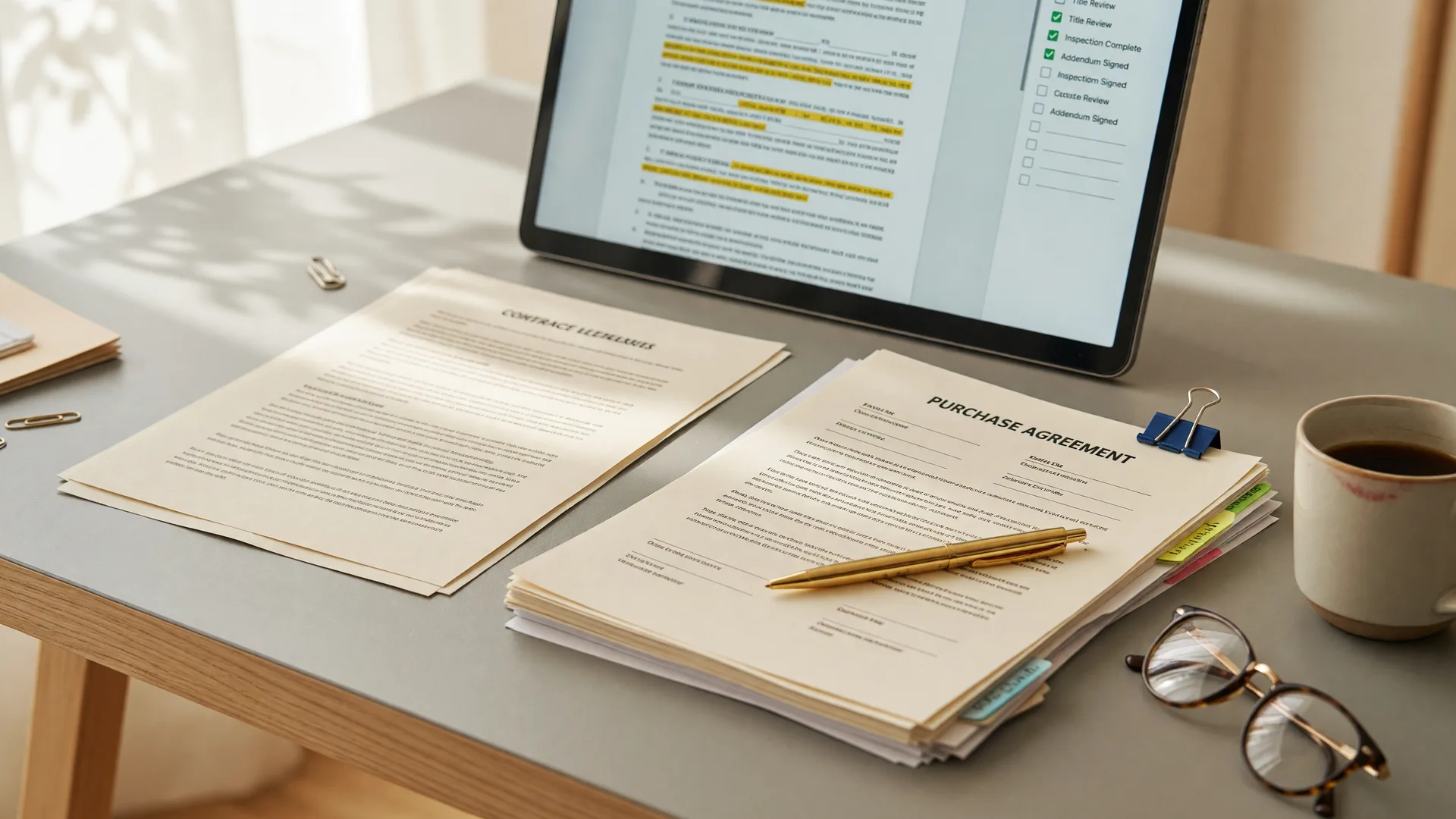
AI will not sign your contracts, but it will stop you from signing a bad one. Every real estate closing runs on 30 to 60 documents, and the mistakes that kill deals are almost never dramatic. They are the wrong closing date, the expired inspection deadline, the addendum that was never attached, the earnest money line that does not match the deposit. In 2026, agents have AI tools that read a purchase agreement in under a minute and flag those errors before they embarrass you in front of a client. Here is how to use them without ever giving up your judgment.
Why Are Contract Errors Still Costing Agents Deals in 2026?
Because most of us still review contracts the way we did in 2005: alone, at midnight, on a second read that never happens. The NAR Technology Report released this September found that 81% of agents now adopt technology to save time, up from 66% a year ago, and 71% adopt it to improve the client experience. Nearly half of Realtors are already using AI daily or weekly for listing descriptions, social posts, and email follow-up. Yet contract review is where agents are slowest to trust the tools, and it is exactly where a second set of eyes pays the most. Transaction teams that adopted AI document review reported cutting deal-closing time by about 31% and document-review costs by roughly 44%, according to legal industry research, and the savings show up as fewer missed deadlines and fewer panicked calls to the closing table.
What Can AI Actually Review in a Purchase Agreement?
Treat AI as the world's fastest proofreader with an attitude for detail. Give it the purchase agreement and it can verify the parties and property match the MLS, check the price math on every line, list every contingency with its calendar date, confirm the addenda are all attached, flag missing initials and signatures on every page, and compute what \"seven business days before closing\" actually means instead of making you guess. Purpose-built tools like ListedKit AI read state purchase agreements and build a transaction timeline in seconds, DocJacket extracts parties, dates, and contingencies with confidence scores, and Dotloop has folded AI document monitoring into its transaction workflow. If your transaction platform is SkySlope, the same idea applies on top of it; I have a full SkySlope best practices guide for the workflow side.
How Do You Run an AI Contract Review the Right Way?
Five steps, in order:
- Upload the actual document, not a summary. Ground the AI in the real text so it reads what you read. Claude or ChatGPT Pro cost about $20 a month and handle a standard agreement easily.
- Give it a checklist, not a blank ask. Ask for flags on ten things: dates, price math, contingencies, addenda, earnest money, concessions, initials, signatures, deadlines, and anything non-standard from your state forms.
- Ask for flags, not rewrites. You want a list of risks with the exact clause quoted, not a prettier contract. Markup tools like Spellbook work inside Word if you want line-level redlines.
- Cross-reference the whole file. Feed the agreement, title commitment, survey, and closing statement together and ask where they disagree. That mismatch list is where deals die.
- Verify every date yourself. AI computes deadlines well now, but you are the one who lives with the calendar. Confirm each one against a normal calendar before it goes to the client.
This is the same interview-first mindset I teach for offer strategy in my AI negotiation prep guide: AI does the heavy lifting, you do the judgment.
How Do You Keep Compliance and Client Trust Intact?
Three rules from three decades of transactions. First, AI is your first pass, never your final word. Your broker, your transaction coordinator, and your attorney still review every packet, and the tools themselves say the same thing. Second, know your brokerage's data rules before you upload; a contract full of client names and addresses is sensitive, so use tools your broker approves and never paste client data into an open chat box. Third, tell your clients what you are doing. There is no shame in it: you are using modern tools to protect their money. What you never do is let AI speak directly to a client as if it were you, or sign anything the machine generated without reading it. The human layer is the product, and that is exactly the point I make when agents ask me about turning AI-researched buyers into clients.
What Does a 30-Minute Contract Check Routine Look Like?
Build it into every offer and every accepted contract. Minute zero: upload the agreement to your AI tool with your ten-point checklist and get the flag list while you are still on the phone. Minute ten: go through each flag yourself, confirm the ones that matter, and add every deadline to your transaction calendar or your CRM. Minute twenty: send the corrected summary with the exact closing date, inspection window, and financing date to your client in plain English. Minute thirty: message your transaction coordinator or attorney with the AI flag report attached and ask for their sign-off. Do that on every file and you will catch the wrong dates before the other side does, which is the cheapest marketing you will ever do. For the system that holds all of it, my CRM best practices guide shows you how to track every deadline in one place.
The Bottom Line
Agents lose deals and credibility to typos, missed deadlines, and addenda that never made it into the file. In 2026 you do not get to blame the paperwork anymore, because a $20 AI assistant plus a 30-minute routine catches nearly all of it before it costs you. Use the tools to check, keep yourself in the final say, and make your clients the best-informed people on their own transaction. That combination is how a seasoned agent sounds, and it is how you keep a client for life. If you want to build this routine into your business, I coach agents on exactly this work. Reach me through my coaching programs or the contact page, or book a call directly at my scheduling link.

Written by Kim Donahue
Kim Donahue is a REALTOR® with Medway Realty serving Sarasota, Manatee, and Charlotte Counties, and a coach with 30+ years of experience across real estate, mortgage, transaction management, and business ownership. She helps agents use AI to protect their transactions and win the paperwork game.
Learn more about Kim