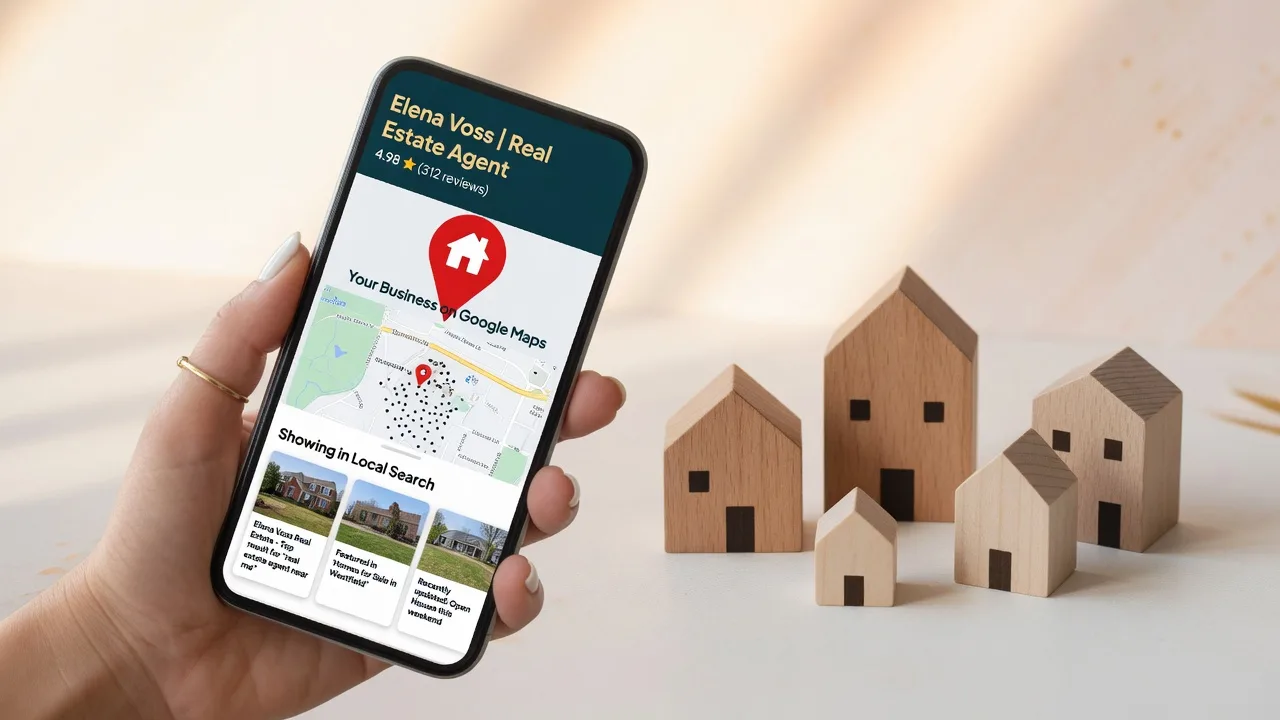
I talk to agents every week who are spending $500, $1,000, even $2,000 a month on Zillow leads, Facebook ads, and third-party lead generation. And then they wonder why their profit margins are thin. Meanwhile, the most profitable agents I know are doing something different. They are investing time in their Google Business Profile and local SEO, and they are getting free, qualified inbound leads every single week.
Here is the truth: when someone in your market searches "real estate agent near me" or "homes for sale in [neighborhood]," the first thing they see is a map with three local agents. If you are not one of them, you are invisible to the most motivated buyers and sellers in your area. And the agent who shows up in that map pack gets the call.
I am Kim Donahue, a REALTOR with Medway Realty, and I have been in this business for over 30 years across real estate, mortgage, and running my own brokerage. I have watched local SEO go from a nice-to-have to the single most cost-effective lead generation channel available to agents. Let me show you exactly how to own it.
Why Should Real Estate Agents Care About Hyperlocal SEO?
Hyperlocal SEO is the practice of optimizing your online presence so you rank in search results for specific, geographically narrow searches: "homes for sale in [your neighborhood]," "real estate agent in [your town]," "best realtor near [local landmark]." It is different from general SEO because it targets people who are already in your market or actively looking to move there.
According to the National Association of Realtors, 97% of home buyers use the internet during their home search, and 44% of buyers start their search by looking at listings online. But here is the part most agents miss: before buyers ever visit a real estate portal, they open Google. They search for the neighborhood. They search for the agent. They search for local market data.
If your Google Business Profile and your website show up for those searches, you capture demand at the very top of the funnel. And you do it without paying a per-click fee or a monthly lead subscription.
Why Hyperlocal SEO Matters Right Now
- 98% of consumers read online reviews before choosing a real estate agent (BrightLocal 2025). Your Google Business Profile is the first place they check.
- The local map pack gets 44% of all clicks on a local search. If you are not in the top three, you are invisible to nearly half of searchers.
- AI-generated search results are pulling from Google Business Profiles and local citations. Answer Engine Optimization (AEO) is becoming as important as traditional SEO.
- Your competition is doing it. The agents who dominate the map pack in your market are investing time in local SEO. You can too, and it costs nothing but focused effort.
How Do You Optimize Your Google Business Profile as a Real Estate Agent?
Your Google Business Profile is your single most valuable free marketing asset. It is the box that appears on the right side of Google search results when someone looks up your name or your brokerage, and it is also the primary factor in whether you appear in the local map pack. Here is how to get it right.
1. Set Your Primary Category to "Real Estate Agent"
This sounds obvious, but I see agents set their category to "Real Estate Agency" or "Property Management" all the time. That is a mistake. The single biggest relevance signal in Google's algorithm is your primary business category. "Real Estate Agent" is the correct category for individual agents. It tells Google exactly what you do and who you serve. You can add secondary categories like "Real Estate Consultant" or "Real Estate Appraiser" if they apply.
2. Fill Out Every Single Field Completely
Google rewards completeness. A fully filled-out profile ranks higher than a partially filled one. Every field is an opportunity to signal relevance. Here is what should be filled:
- Business name: Your exact name as you use it professionally. If you work under a team name, list it consistently
- Address: Your brokerage address. If you work from home, check with your brokerage about their policy on listing home addresses
- Phone number: A local number with your area code. A local area code signals geographic relevance
- Website: Your personal agent website, not your brokerage's corporate site
- Hours of operation: Set accurate hours, including weekend availability. If you take calls on Sunday, put Sunday hours
- Service areas: List the specific neighborhoods, cities, and counties you serve. This is where hyperlocal keywords matter most
- Attributes: Mark yourself as a real estate agent, and indicate that you offer online estimates, free consultations, and virtual appointments
3. Write a Description That Uses Local Keywords
Your Google Business Profile description is a short paragraph (up to 750 characters) that tells Google and potential clients who you are and what you do. Use it to include your target neighborhoods, your specialty, and your unique value proposition. Here is an example:
Notice the local keywords: Sarasota, Manatee, Charlotte Counties, luxury waterfront, first-time buyers, relocation. These are terms real people search for.
4. Add Photos and Videos Every Week
Google Business Profiles with photos get 42% more requests for directions and 35% more clicks to their website. Listings with video get even more engagement. Post a mix of content every week:
- Professional headshots and lifestyle photos (you already have these)
- Listing photos and virtual tours of current listings
- Neighborhood walkthrough videos and market updates
- Behind-the-scenes content — at the office, at a closing, at a community event
- Sold properties with "just sold" graphics
Google's algorithm favors profiles that are actively maintained. A profile that gets new photos every week signals that you are an active, engaged agent.
How Do You Get More Google Reviews and Do They Matter?
Reviews are the single most powerful ranking factor for local SEO after your category and proximity. They also directly influence whether a prospective client chooses you over the other two agents in the map pack. Here is what the data shows:
- Agents with 25+ reviews rank significantly higher than agents with fewer than 10
- The average home buyer reads 8 to 10 reviews before choosing an agent
- Review recency matters: a steady stream of new reviews (even 1-2 per week) signals ongoing activity
- Detailed reviews with specific language (mentioning neighborhoods, services, or outcomes) carry more weight than one-word reviews
Here is the system I teach agents for getting consistent reviews without being pushy:
- Ask at the right moment. The best time to ask for a review is immediately after a positive interaction — right after a successful closing, after a client sends a thank-you text, or after you receive a compliment. Strike while the feeling is fresh
- Send a direct link. Do not make clients search for your profile. Use the Google Place ID tool to generate a direct review link and send it via text or email. Make it a two-click process
- Make it easy. Some clients do not know what to write. Offer a suggested prompt: "Would you be willing to share your experience working with me, especially how I helped you find your home in [neighborhood]?"
- Respond to every review. Respond to positive reviews with a thank-you. Respond to negative reviews professionally and constructively. Google sees responsiveness as a quality signal
What Is Hyperlocal Content and How Do You Create It?
Hyperlocal content is the secret weapon of agents who dominate local search. It is content that is so specific to a neighborhood, a street, or a community that it can only come from someone who truly knows the area. Here is what that looks like:
- Neighborhood guides: "Living in Southside Village: A Complete Guide to Sarasota's Most Walkable Neighborhood" with details on restaurants, parks, schools, and home prices
- Market reports by zip code: "Siesta Key Market Report: June 2026 Home Sales and Price Trends"
- Local business spotlights: A video or blog post featuring a local coffee shop, restaurant, or boutique. Tag the business and cross-promote
- School feature stories: "What Parents Should Know About [Local School Name]" covering test scores, extracurriculars, and the enrollment process
- Community event coverage: Attend and document local farmers markets, art walks, holiday parades, and charity events
- "Just Sold" and "Just Listed" posts: Share these on your GBP, your website, and social media. Each one is a signal to Google that you are active in that specific area
Each piece of hyperlocal content gives you a page that can rank for a specific neighborhood search. Over time, you build a library of pages that collectively position you as the local expert for every corner of your market.
How Do You Build Local Citations and Backlinks?
Citations are mentions of your name, address, and phone number (NAP) on other websites. Backlinks are links from other websites to yours. Both are important ranking signals for local SEO. Here is where to start:
- Claim and verify your profile on every major directory: Zillow, Realtor.com, Trulia, Homes.com, Yelp, Bing Places, Apple Maps, and the local Chamber of Commerce directory
- Ensure your NAP is exactly the same on every platform. Google trusts consistency. A different suite number, a missing "Suite," or a slightly different phone format can hurt your ranking
- Get listed on local business directories and community websites. Sponsor a local Little League team, join the Rotary Club, or partner with a local charity. Most of these organizations list their sponsors online with a link
- Write guest posts for local real estate blogs, community newsletters, or the local newspaper's real estate section. Each guest post earns you a backlink and builds local authority
- Partner with local lenders, title companies, and home inspectors. Many of them have "partner" pages where they link to the agents they recommend
What Is Answer Engine Optimization and Why Should Agents Care?
Answer Engine Optimization (AEO) is the practice of structuring your content so it gets picked up by AI-powered search tools like ChatGPT, Google AI Overviews, Perplexity, and Claude. These tools are increasingly how people search for real estate information. Instead of browsing 10 blue links, they ask a question and get a single answer.
To optimize for AEO, structure your content around clear questions and answers. Use question-based headings (like the ones in this article). Write concise, authoritative paragraphs that directly answer the question. Include practical data, step-by-step instructions, and specific examples. This is the exact format that AI search tools pull from.
When a potential client asks their AI assistant "Who is the best real estate agent in Sarasota?" or "How do I sell my home in Lakewood Ranch?" the AI pulls from content that is structured this way. If your content is organized as clear Q&A, you get the call. If it is not, you do not.
Your Hyperlocal SEO Action Plan: What to Do This Week
Local SEO is not a set-it-and-forget-it project. It is an ongoing investment of time that compounds over months. But you can get started today with this seven-day plan:
- Day 1: Claim or audit your Google Business Profile. Verify your category is "Real Estate Agent" and fill out every field completely.
- Day 2: Write your GBP description with local keywords. Add 5 professional photos including your headshot and a listing photo.
- Day 3: Send a review request to your last 5 past clients. Use a direct link to your Google review page.
- Day 4: Audit your NAP consistency across all directories. Fix any discrepancies between Zillow, Realtor.com, Yelp, and your brokerage website.
- Day 5: Write and publish your first neighborhood guide. Pick the neighborhood you know best and write a 500-word guide with local keywords.
- Day 6-7: Post a photo or video to your Google Business Profile. Then set a recurring weekly reminder to add new content every week.
The Bottom Line
Hyperlocal SEO and Google Business Profile optimization are the most cost-effective marketing investments you can make as a real estate agent. They require time and consistency, not money. Every fully optimized profile, every neighborhood guide, every review you earn, and every local citation you build compounds over time. Six months from now, you will be the agent who shows up when someone searches for your neighborhood. And that agent gets the call.
Want help auditing your Google Business Profile or building your local SEO strategy? Book a free strategy call with Kim Donahue for personalized guidance on getting found in your market without paying for leads.

Written by Kim Donahue
Kim Donahue is a REALTOR with Medway Realty and a coach with 30+ years of experience across real estate, mortgage, and business ownership. She specializes in helping agents leverage AI, marketing, and modern strategies to build stronger businesses.
Learn more about Kim