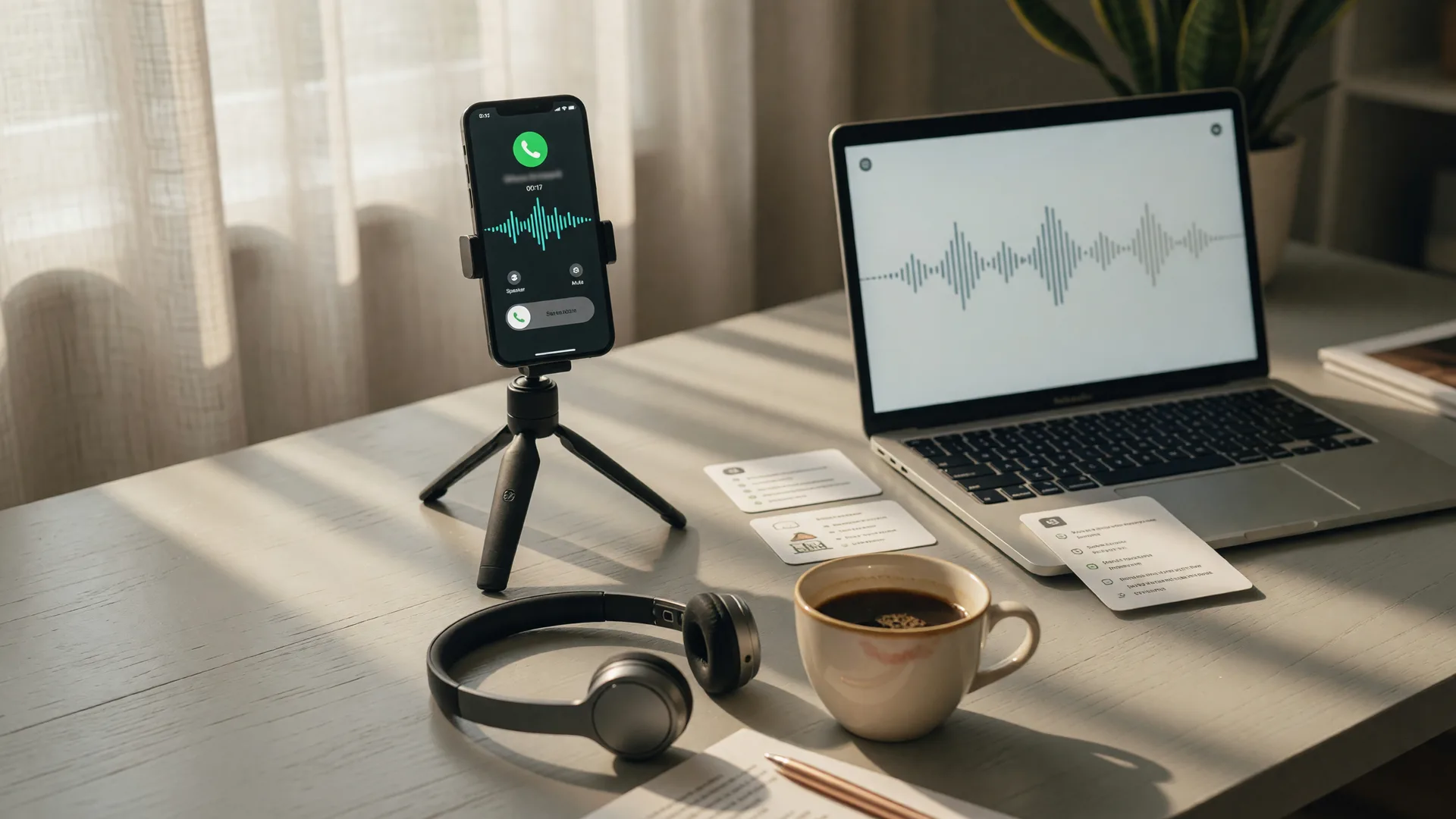
The most valuable market data you will ever own is already inside your phone's call history. Every consultation, every listing appointment, every check-in call contains the words that win or lose deals, and most agents walk away carrying maybe 20 percent of what was said. AI transcription and conversation intelligence change that. Here is the 2026 system for recording, summarizing, and acting on every conversation.
Why Do Real Estate Agents Lose Half of What Clients Tell Them?
It is not because you are a bad listener. It is because you are human. A 45-minute buyer consultation has more facts than anyone can hold: the timeline, the financing, the two neighborhoods they keep circling, the school question they almost asked, the real reason they are moving. By the time you write your notes, the sharp edges are gone, and a week later the detail that would have led you to the perfect showing is gone entirely. In 2026 clients arrive prepared, having researched neighborhoods and formed opinions about price before they call, so the agent who remembers their story wins them.
What Is Conversation Intelligence for Real Estate Agents?
Conversation intelligence is the category of AI tools that record, transcribe, summarize, and surface insights from your client conversations. It works in three layers. Transcription turns the audio into searchable text you can reread anytime. Summarization writes a clean recap with the client's needs, timeline, motivation, and next steps. Intelligence syncs that recap to your CRM, flags action items, and over time shows you the patterns across your conversations: the objection that keeps killing your listings, the financing gap every buyer in your market shares.
Think of it as hiring a perfect note-taker and a sales coach at once, for less than the cost of one missed detail. I started using these tools because I was tired of losing listing appointments to agents who remembered the seller's dog's name, the grandkid's birthday, and the exact "we want to be out by June" timeline. The client gives that information to whoever earns it with attention, and AI gives you the attention span to earn it every time.
How Do You Record Client Calls Legally and Ethically?
Permission first, always. Florida is a two-party consent state, which means everyone on the call must agree to be recorded. Get that permission on the recording itself: "Do I have your okay to record this call so I can take perfect notes and never miss a single detail?" Almost everyone says yes, because it is honest and it serves them. If someone declines, take notes the old-fashioned way and move on. This is not a suggestion; it is the law here, while other states only require one party's consent. Check your state's law and your brokerage's policy before you hit record.
A transcript gathered without consent is worse than none at all. Treat every recording like the private document it is: store it with your client's information, share it only with people who need it, and never post it publicly. Clients trust you with their home and their money. Their words deserve the same care.
Which AI Transcription Tools Should Real Estate Agents Use in 2026?
You do not need a stack of expensive software to start. Otter.ai offers about 300 free minutes of transcription a month and joins Zoom, Google Meet, and Teams calls, making it the most common starting point I see. Fathom records, transcribes, and summarizes video calls free. Fireflies.ai auto-joins your calendar calls and emails summaries, so brokerages use it to keep one searchable record of every client interaction. For in-person conversations at showings or listing appointments, a wearable recorder like Plaud's AI NotePin captures the meeting without a laptop sitting between you and the client.
The bigger shift in 2026 is that the CRM now does the listening. Platforms like Follow Up Boss and Lofty link call recordings and AI summaries straight to the lead record, so the transcript lives exactly where your follow-up happens. Start with one meeting tool and one call capture tool.
How Do You Turn a Transcript into Action Items in Five Minutes?
Transcription only pays off if the notes turn into activity. Here is the exact five-minute workflow I coach:
- Summarize with a fixed structure. Ask your AI to answer eight questions: Who is this client? What do they want? When do they need it? What are the money facts? What is really motivating the move? What fears or objections came up? What did I promise? What happens next?
- Save the summary in the CRM contact record. Paste the recap into their notes or let the CRM's built-in AI do it. Now the whole story travels with the client, and your CRM best practices stay intact.
- Create the next task before you close the laptop. A showing, a call to the lender, a comp pull, a follow-up date. If it is not in the task list, it did not happen.
- Send a personalized one-tap recap. "Per our call, I am pulling three comps in Lakewood Ranch and will text them by Friday. You mentioned wanting to be out by June, so we will work backward from there." Clients feel heard when you prove you heard them.
That last step is where deals close. In an industry drowning in leads and starving for attention, a recap that proves you listened is a competitive weapon nobody can copy. Pair it with the follow-up cadence in my automated lead nurture guide and the response becomes the centerpiece of your nurture sequence.
What Should You Listen For in a Listing Appointment?
The transcript of a listing appointment is a goldmine. Listen for the five things that win listings. First, the real reason for selling: "we just want to try something different" usually means something specific underneath, and the agent who names it closes it. Second, the real timeline: a seller who says "no rush" but is closing on a new build in five months is on a deadline. Third, the price story in their head: they have watched their neighbor sell, and that comp shapes every expectation you will negotiate. Fourth, the commission objection, which almost always shows up as a pause before "that seems like a lot." Fifth, the fear: "what if it does not sell in this market?"
Then listen to yourself. Count how long you talked versus how long the seller talked. Where did you rush, over-explain, or answer your own questions? The transcript is the tape your coach would replay with you, and it costs nothing to run. My listing appointment playbook gives you the structure, and the transcript tells you how well you executed it.
How Do You Use Call Reviews to Coach Yourself?
Once a month, replay your worst call of the month with your transcript, the one where you lost the client or fumbled the objection. Ask three questions: Where did the conversation turn? What did I miss? What would I say differently next time? Write the better response down. After three months you will see patterns, a pricing objection you never handled well, a step you skipped, a question that made clients open up. Fix the pattern once and every future call improves.
This is exactly how I coach agents one on one, using their real conversations instead of role plays. If you want a second set of eyes on your calls, my coaching programs cover it, and we start from what your own transcripts reveal.
What Mistakes Should You Avoid with AI Transcription?
Five mistakes sink most agents who try this. Recording without consent, which is both illegal in two-party states and a trust disaster. Pasting client conversations into a public AI chatbot; use tools with private handling instead. Letting the transcript replace the relationship by sending the summary and skipping the actual call. Buying five subscriptions before using one. And recording everything but never reading any of it, which is just a more expensive way to forget.
The Bottom Line
AI call transcription does not make you less human; it makes you more present, because it stops you from scrambling to remember and lets you focus on the person in front of you. Half your competition already uses AI, and the other half is about to catch up. The tools cost little, the workflow takes five minutes a call, and the payoff is a memory that never misses a deadline, objection, or detail. If you want to build this system into your business, reach me through my coaching programs or the contact page, or book a call directly at my scheduling link.

Written by Kim Donahue
Kim Donahue is a REALTOR® with Medway Realty serving Sarasota, Manatee, and Charlotte Counties, and a coach with 30+ years of experience across real estate, mortgage, transaction management, and business ownership. She helps agents use AI and modern systems to win more clients without losing the human touch.
Learn more about Kim